 |
Deluge Firmware 1.3.0
Build date: 2026.10.14
|
|
Deluge Firmware 1.3.0
Build date: 2026.10.14
|
Pure arithmetic used by WaveformRenderer to find per-column waveform peaks. More...
#include <cstdint>#include <optional>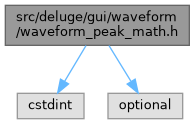
Go to the source code of this file.
Classes | |
| struct | deluge::gui::waveform::Peak |
| Minimum and maximum of a run of raw 32-bit-aligned sample values. More... | |
Functions | |
| Peak | deluge::gui::waveform::scanPeak (const char *data, int32_t start, int32_t end, int32_t byte_depth, int32_t num_channels) |
| Finds the subsampled min/max over part of a Cluster's raw audio data. | |
| int8_t | deluge::gui::waveform::coarsePeak (int32_t value) |
| Reduces a 32-bit peak to the 8-bit form stored in SampleCluster::minValue / maxValue. | |
| int32_t | deluge::gui::waveform::lastClusterEnd (uint64_t audio_bytes, uint32_t audio_start, int32_t cluster_size) |
| Finds where the audio ends within the last Cluster that holds any. | |
| int64_t | deluge::gui::waveform::clusterStart (int32_t index, int32_t size_log2) |
| Finds a Cluster's byte offset within its file, without overflowing for files over 2 GB. | |
| int32_t | deluge::gui::waveform::firstFrameOffset (int64_t cluster_start, uint32_t audio_start, int32_t frame_size) |
| Finds where the first whole audio frame starts within a Cluster. | |
| std::optional< int32_t > | deluge::gui::waveform::columnShift (int64_t delta, int64_t zoom, int32_t width) |
| Works out whether a scroll moved the view by a whole number of columns. | |
| void | deluge::gui::waveform::remapColumns (WaveformRenderData &data, int64_t scroll, int64_t zoom) |
| Carries cached per-column peaks over to a new scroll and zoom, so they needn't all be worked out again. | |
Variables | |
| constexpr int32_t | deluge::gui::waveform::kMaxScanSamplesLog2 = 9 |
| log2 of the most samples scanPeak() reads per call; longer spans are subsampled. | |
Pure arithmetic used by WaveformRenderer to find per-column waveform peaks.
Nothing here touches the engine or hardware, so it's covered by the host unit tests (tests/unit/waveform_peak_math_tests.cpp).
| int64_t deluge::gui::waveform::clusterStart | ( | int32_t | index, |
| int32_t | size_log2 ) |
| int8_t deluge::gui::waveform::coarsePeak | ( | int32_t | value | ) |
Reduces a 32-bit peak to the 8-bit form stored in SampleCluster::minValue / maxValue.
| value | Full-scale 32-bit sample value. |
| std::optional< int32_t > deluge::gui::waveform::columnShift | ( | int64_t | delta, |
| int64_t | zoom, | ||
| int32_t | width ) |
Works out whether a scroll moved the view by a whole number of columns.
AudioClip converts its scroll from ticks to samples with integer division. So scrolling by one column can land up to one sample per column moved away from an exact multiple of zoom. That much slack is accepted, as long as it stays under half a column.
| delta | New scroll minus old scroll, in samples. |
| zoom | Samples per column. Must be positive. |
| width | Number of columns. Moves further than this leave nothing to reuse. |
width columns. | int32_t deluge::gui::waveform::firstFrameOffset | ( | int64_t | cluster_start, |
| uint32_t | audio_start, | ||
| int32_t | frame_size ) |
Finds where the first whole audio frame starts within a Cluster.
Frames are laid out from audio_start, so with non-power-of-two frame sizes (e.g. 24-bit) a Cluster usually begins part-way through a frame.
| cluster_start | The Cluster's byte offset within the file, from clusterStart(). |
| audio_start | Offset of the audio data within the file. |
| frame_size | Bytes per frame (num_channels * byte_depth). |
| int32_t deluge::gui::waveform::lastClusterEnd | ( | uint64_t | audio_bytes, |
| uint32_t | audio_start, | ||
| int32_t | cluster_size ) |
Finds where the audio ends within the last Cluster that holds any.
Rounds up, so audio that ends exactly on a Cluster boundary gives a full Cluster rather than 0.
| audio_bytes | Length of the audio data in bytes. |
| audio_start | Offset of the audio data within the file. |
| cluster_size | Cluster::size. Must be a power of two. |
cluster_size. | void deluge::gui::waveform::remapColumns | ( | WaveformRenderData & | data, |
| int64_t | scroll, | ||
| int64_t | zoom ) |
Carries cached per-column peaks over to a new scroll and zoom, so they needn't all be worked out again.
For each new column, looks at the old columns it overlaps:
For a whole-column scroll at the same zoom, columnShift() and sliding the arrays across gives the same result more cheaply.
| data | The cache to remap. Its xScroll and xZoom describe the columns it holds now, and are left alone. |
| scroll | New sample position of the left edge of column 0. |
| zoom | New samples per column. Must be positive. |
| Peak deluge::gui::waveform::scanPeak | ( | const char * | data, |
| int32_t | start, | ||
| int32_t | end, | ||
| int32_t | byte_depth, | ||
| int32_t | num_channels ) |
Finds the subsampled min/max over part of a Cluster's raw audio data.
Reads at most about 2^kMaxScanSamplesLog2 samples, striding over the rest. For stereo the stride is forced odd so both channels get sampled. Each read is a 32-bit load offset by byte_depth - 4, so it lands on a sample's most significant bytes. For 8/16/24-bit data that indexes slightly before start, which is valid because Clusters keep padding bytes before their data.
| data | Cluster::data of the Cluster being read. |
| start | First byte to read, relative to data. Should be frame-aligned. |
| end | Byte after the last one to read, relative to data. |
| byte_depth | Bytes per sample (1-4). |
| num_channels | 1 or 2. Both channels are counted as samples. |