

19.2 CV Connections & Compatibility
CV
CV is a classic legacy technology used in the 1970’s prior to the development of the MIDI standards. This uses a gate signal to trigger a note or event followed by a CV value to control the note pitch or value of the destination parameter although standards and compatibility for CV is less defined.
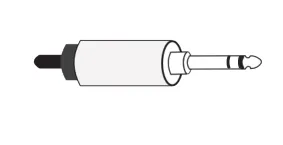
Deluge has 4 gate and 2 CV outputs which can be used to control external CV gear.
CV means ‘control voltage’ and typically controls pitch although other parameters can be controlled especially within modular setups.
Deluge CV output is 0v to 10v.
CV and gate are notoriously nonstandard. Different synthesizers expect to see pitch represented with voltage according to different standards, and their gate / trigger inputs may be either polarity.
The Deluge has been designed to support the widest range of CV / gate standards possible. A number of settings are available in the settings menu.
Each CV output may be set, in 0.01V increments, to any value between
- 01V and 2.00V per octave, or to “Hz per volt”. Analog synthesizer manufacturers typically adopt one of several standards, examples are:
- Hz per volt - used by Yamaha and Korg (*).
- 1V per octave - used by Moog, Roland, ARP and Doepfer (*).
- 1.2V per octave - used by Buchla and EML (*).
- 0.32V per octave - used by EMS (*).
- 0.26V per octave - used on oscillator 3 of the EMS VCS3 (*).
Gate
Gate is a control signal which accompanies CV control settings. Where CV controls pitch, gate controls the note on and off signals. Sometimes gate is also called trigger. Typically gate signals trigger an ADSR envelope but can also trigger a clock and other functions such as an LFO.
Deluge gate output can be switched between 5v and 12v. This switch is located on the top surface near the rear of Deluge. Each gate output may be set to either of:
- V-trig - represents a note being on by outputting a positive voltage (12V or 5V selectable), and outputs 0V the rest of the time. Used by Roland, Sequential Circuits and ARP.
- S-trig - represents a note being on by “shorting” out the output to ground. When the note is off, the Deluge “pulls up” the output’s voltage to 12V or 5V (selectable) with a 10K resistor: this is not a strict part of the S-trig standard but many devices do this and it is believed to be fully compatible and safe (see disclaimer), and is in fact necessary (*) for Yamaha synthesizers. S-trig is used by Yamaha, Korg and Moog.
.
Trigger clock
The Deluge has a “trigger clock” input, allowing it to play as a follower to hardware which outputs a clock signal containing any number of “pulses per quarter-note” (PPQN). It can accept any voltage between 3.3V and 12V. Clock steps are read on the rising edge of the pulses. A device which has a DIN SYNC output could have pin 3 of this connector routed to the tip of the Deluge’s trigger clock input. PPQN can be set, along with an auto-start setting, in the settings menu. See the MIDI section for more information about having the Deluge play as a follower to an external clock source (which could also be a MIDI beat clock). If you wish to use the Deluge as a syncing leader to send a trigger clock signal to other devices, gate output 4 can be set to output a trigger clock signal, and / or gate 3 can be set to output a “run” signal (goes high while playback is occurring; low otherwise). These output assignments are accessible via the settings menu, as is the trigger clock output PPQN setting.